
View This Page In French
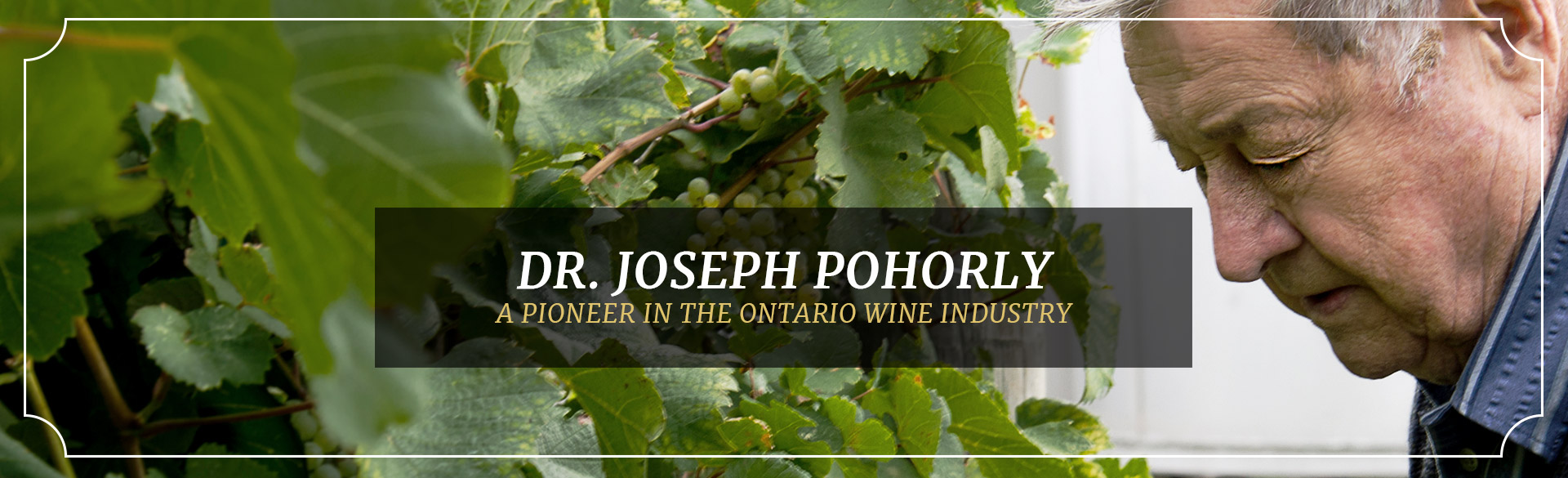
Joseph Pohorly was one of the first Canadian Icewine pioneers. He initially made Icewine for Hillebrand Estates Winery – the winery he founded as Newark Winery – in 1983, and helped launch the Icewine revolution in Canada. Joseph chose the Vidal grape for this early experiment because its thicker skin can withstand colder temperatures and help the grape last longer on the vine without decaying or breaking down. Vidal also produces a beautiful floral nose, with an apricot and honeyed flavour.
Although Icewines had been made in Germany and Austria for several hundred years, it took the Canadian winemakers to raise this precious nectar to new heights. Today, almost every winery in Niagara makes Icewine. In fact, Niagara produces about 80% of the Canadian Icewine supply.
At Joseph’s, we pride ourselves on our Vidal Icewine, made to exacting VQA standards and representative of the best in the industry. This stellar beverage has won numerous national and international awards, including many gold medals, and continues to be one of our flagship products. In 2001, our ’98 VQA Vidal Icewine captured the “Grand Champion American Airlines Trophy” for the Best Commercial Dessert Wine at the Indy International Wine Competition in Indianapolis, Indiana. More than 3,000 wines from 17 countries were entered in this prestigious competition.
The production of Icewine in Canada is monitored by VQA, which has established strict rules that govern how it is made.
In late September, grapes intended for Icewine are netted to prevent hungry birds from eating them as the weather gets colder and food supplies get scarce. Throughout the fall and early winter, the repeated freezing and thawing of the grapes on the vines concentrates their sugars and acids, which intensifies the flavors. Icewine grapes must be frozen on the vine and are harvested only after the temperature drops between –8°C to –12°C, which usually occurs in mid-winter.
Due to the late harvest and extended “hang” time of the grapes, and the fact that the juice is already concentrated from the natural freezing, the grapes produce an extremely low yield of juice. Often, an entire vine will only produce a single bottle of Icewine.
Icewine grapes must be hand picked, as the frozen vines are delicate at this stage, and some of the grapes have already been captured in the netting. To ensure that the grapes remain frozen, the Icewine harvest takes place at night when the temperature is the coldest and the grapes don’t have a chance to thaw.
The grapes are pressed immediately outdoors where the rare, sweet drops are coaxed and separated from the grape’s frozen water content. These drops, which are like grape syrup, are fermented and aged in our cellar for about six months until the golden nectar is ready for bottling.
This excellent wine has won many Double Gold and Silver medals. Our 1999 Vidal Icewine won a very prestigious award at the 2003 All Canada Wine Championship, Windsor, Ontario – May 24/03 for “Best of Category” being the Best Dessert Wine in Canada. In addition, the 2001 Cabernet Franc Icewine and 1998 Vidal Icewine won Double Gold at the International Eastern Wine Competition, Watkins Glen, NY – May 21/03. At the Finger Lakes International Wine Competition, Rochester, NY – March 29/03 both the 1999 Vidal Icewine and 2001 Cabernet Franc Icewine finished with a Silver medal.
Serve Icewine well chilled alone or paired with dessert, chocolate or fruit.

